
The Unspoken Language of Horses: What Your Ride Is Telling You Without Words
There is a moment that happens in almost every first lesson I have ever taught.
The rider (usually someone who has never been near a horse before, maybe a kid from Windsor who talked their parents into this, maybe an adult from Santa Rosa who has wanted to try it for years) gets into the saddle. They sit up straight. They hold the reins. And then the horse does something completely ordinary, like shift its weight or flick an ear, and the rider freezes.
"What did that mean?" they ask.
It is the right question. It is always the right question.
Because horses are talking to you constantly. Every step, every ear position, every exhale is information. The whole ride is a conversation. And the sooner a rider learns to listen, really listen, the sooner everything clicks.
This is the part of riding nobody puts on the poster. But after years of teaching students across Windsor and Santa Rosa, I think it might be the most important thing we teach.
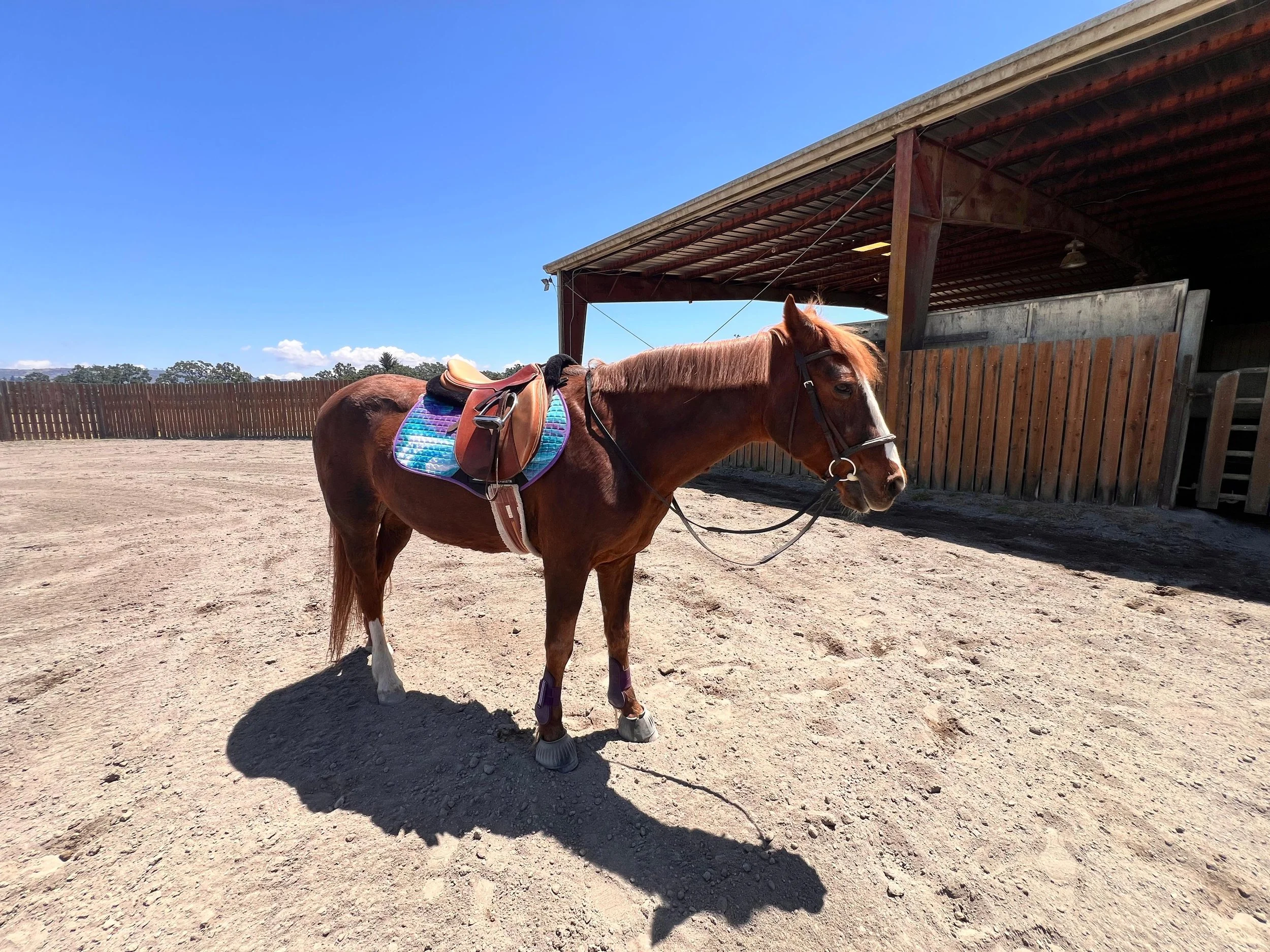
Horses Don't Have a Poker Face
Humans are remarkably good at hiding how we feel. We smile when we are nervous. We say "fine" when we are not. We show up and perform.
Horses cannot do any of that. They are incapable of pretending.
When a horse is relaxed, you will see it in everything: the soft eye, the low neck, the easy rhythm of breathing, the hind leg cocked at rest. When something has their attention, the ears come forward and the body tightens almost imperceptibly. When they are uncomfortable, they will tell you through their tail, their mouth, the tension in their back.
None of this is subtle once you know what to look for. But to someone who has never had to pay attention to a 1,200-pound animal before, the signals can feel completely invisible at first.
That is exactly what we work on in our lessons at Strides Riding Academy, and why students who start with us in Windsor and Santa Rosa often tell us that learning to read a horse changed the way they pay attention to everything else too.
The Ears Are the Dashboard
If I had to pick one place to tell a new rider to start, it would be the ears.
A horse's ears are almost always pointing at whatever the horse is thinking about. Both ears forward means something ahead has their full attention. Could be another horse, a noise in the distance, a plastic bag caught in the fence. One ear forward, one back often means they are splitting their focus: part of them is listening to you, part of them is tracking something else. Both ears relaxed and flopping slightly sideways means you have a content, at-ease horse underneath you.
What this means for a rider is practical and immediate: if you are asking your horse to canter and one ear is pinned back toward you, they heard you. If both ears are locked on a bird in the oak tree at the edge of the arena, you may want to ask again. They are a little somewhere else right now.
Learning to read the ears gives riders in our Windsor and Santa Rosa programs a real-time window into the horse's mind. It turns riding from guesswork into dialogue.
The Tail Tells the Truth
The tail is one of the most honest parts of a horse, and one of the most overlooked.
A relaxed, gently swinging tail during a ride usually means things are going well. A tail that is clamped down tight, pressed toward the hindquarters, often signals tension or discomfort. A tail that is swishing hard and rhythmically, in a way that is not about flies, usually means the horse is frustrated or annoyed. And a tail that is raised high, almost flag-like, often means energy is rising. That horse is feeling themselves.
I tell students this all the time: you can learn a lot about how a ride is going without looking at the horse's face at all. Just check in with the tail every so often. It will rarely mislead you.
What Tension in the Back Is Trying to Say
This one is harder to feel than to see, but it is worth mentioning because it is one of the most common things newer riders miss.
A horse that is moving freely, with a swinging, supple back, is a horse that is relaxed and working well. A horse with a tight, braced back (one that feels stiff or choppy rather than fluid) is often telling you something: maybe they are stiff, tense, not quite with you mentally.
In our lessons, we spend a lot of time helping riders feel the difference. Because once you can tell the difference between a horse that is loose and swinging underneath you versus one that is holding something, you start to understand that riding is not about sitting on top of an animal and steering. It is about creating a partnership that feels good for both of you.
That shift in perspective, from passenger to partner, is one of the most meaningful things that happens for our students, whether they are first getting started in Windsor or have been riding in Santa Rosa for a year and are ready to go deeper.
The Breath
Here is one most people do not expect: pay attention to when your horse exhales.
A long, slow exhale, sometimes with a bit of a snort, is one of the clearest signs of relaxation and release in a horse. It means they have let something go. Some tension they were holding, some uncertainty they felt, some anticipation they had built up. They are breathing out. They are okay.
I notice this most during groundwork, or in the moment right after a horse and rider find their rhythm together. The horse takes this slow, quiet breath, and the rider, if they are paying attention, feels it too.
There is something about that moment. It is small and easy to miss if you are focused elsewhere. But when you catch it, it feels like the horse is saying: yes, this. This is working.
We hear a lot of those breaths in our lessons across Windsor and Santa Rosa. They tend to happen right around the time a rider stops trying so hard and starts actually listening.
Why This Matters Beyond the Arena
I will be honest with you: I did not set out to teach communication skills. I set out to teach riding.
But I have watched this happen too many times to ignore it. Students who learn to read a horse, who develop the patience to notice, the stillness to listen, the self-awareness to adjust, tend to carry those skills with them.
I have had parents from Windsor tell me their kid suddenly started noticing when a sibling was upset before anyone said a word. I have had adult riders in Santa Rosa tell me the patience they developed in the saddle started showing up in how they managed conflict at work. I have watched teenagers who came in with their eyes down and headphones on gradually develop this quiet attentiveness, this capacity to be present, that is genuinely rare.
Horses do not know they are teaching any of this. They are just being horses. Responding to what is in front of them with complete honesty, asking for partnership, offering it in return when they find it.
But the effect is real. And it starts from the very first lesson.
Ready to Start the Conversation?
If you are in Windsor, Santa Rosa, or anywhere in the surrounding area and you have been thinking about riding lessons, for yourself, for your child, for your family, we would love to meet you.
At Strides Riding Academy, this is exactly what we teach: not just how to ride, but how to pay attention. How to listen to an animal that has a lot to say and no words to say it with. How to show up fully present and discover what that makes possible.
→ Learn more about our riding programs → Contact us or book a lesson
We serve riders from Windsor, Santa Rosa, Petaluma, Healdsburg, and across Sonoma County. Starts from 5 years old, all experience levels. You do not need to know anything to get started, just a willingness to pay attention.
The horses will take it from there.
Strides Riding Academy offers horseback riding lessons for kids and adults in Windsor and Santa Rosa, CA. Our programs are designed for all experience levels, from first-timers to riders preparing for competition.