
Communication 101, Taught by a 1,000-Pound Teacher
It happens in almost every beginner lesson, sooner or later. A young rider gives a horse a cue, the right word, the right signal, exactly the way they were taught. And the horse doesn't move.
The rider tries again, a little louder or a little more insistent, the way children do when they assume the problem is volume. Still nothing. By the third attempt, their shoulders have crept up toward their ears, their grip on the reins has tightened, and their voice has an edge to it that wasn't there a minute ago.
That's usually the moment an instructor steps in, not to fix the words, but to point out something the rider hasn't noticed: their hands are tense, their breath is shallow, their whole body is holding itself like it's bracing for something. They're saying "walk on," but everything else about them is saying something closer to "don't."
The horse is listening to the body. The body is the one sending the wrong message.
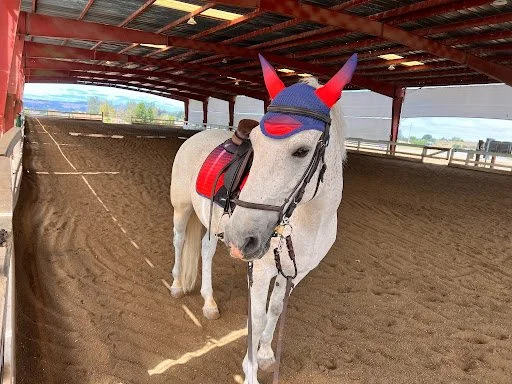
The Gap Between What Riders Say and What They Send
Anyone who has ever heard a child insist they're "fine" while slamming a bedroom door already understands this gap. Children, like most people, learn the right words long before they learn to actually align those words with everything else they're communicating: tone, posture, energy, timing.
This is one of the quiet reasons communication breaks down so often, at school, at home, between friends. A rider can say something perfectly reasonable and still get an argument, a shutdown, or a blank stare back, because the person on the other end is responding to more than the sentence. They're responding to everything underneath it.
Most activities don't have a clean way to make that gap visible. A coach can tell a child to "communicate with the team," but the feedback is slow and easy to miss. A classroom can teach vocabulary, but it can't show a rider, in real time, that their tone just undercut their own words.
A horse can. Immediately, and without an ounce of judgment attached to it.
What Usually Happens Next
The fix is rarely complicated. An instructor will often ask a tense rider to do one simple thing: take a breath, loosen their hands. Nothing about tone of voice. Nothing about word choice at all.
More often than not, the rider tries it, half-convinced it won't matter, drops their shoulders, lets out a breath, and gives the cue again. This time, without the edge behind it.
And the horse walks on.
That moment tends to land harder than any explanation could. The rider didn't change their words. They changed what was actually underneath them, and the horse responded to that instantly. Nobody had to lecture them on the difference between saying something and meaning it. They felt it happen in real time.
The Speed of the Feedback
What makes this kind of moment different from a typical conversation about communication is the speed of the feedback. There's no lag between the mistake and the correction, no vague sense of "try harder." A rider feels the mismatch and feels the fix, back to back, often within the same minute. That kind of learning tends to stick in a way that advice rarely does.
This plays out constantly at Strides, in small ways that build over weeks and months. A rider who's frustrated after a rough day at school brings that frustration into the arena, and the horse responds to the frustration, not the cue. A rider who's rushing and distracted gets a horse that won't settle. A rider who's nervous but trying to hide it gets a horse that stays just as unsettled right alongside them.
None of this is a punishment. It's information, delivered without an opinion attached, which makes it a lot easier for riders to actually absorb.
What Parents Actually Notice
Most parents aren't looking for their child to become a polished public speaker. What they're actually noticing, and what tends to bring families through our doors at Strides, is something closer to this: their child says one thing and means another. Their child struggles to read when a friend is upset. Their child gets frustrated that people "don't listen," without realizing they're sending mixed signals themselves.
These aren't character flaws. They're communication gaps, and most riders don't get a low-stakes, repeatable way to actually close them. School rarely offers real-time feedback on body language. Friend groups don't usually explain why a child keeps getting left out of the conversation. It just happens, and riders are left guessing why.
Riding closes that gap in a way that's hard to argue with, because the horse isn't grading anyone's personality. It's just responding honestly to what's actually being communicated, cue by cue, ride by ride.
What Changes Outside the Arena
Parents tend to notice the shift before their children can explain it themselves. A rider who used to raise their voice to get what they wanted starts trying a calmer approach first, because they've felt firsthand how much further calm actually gets them. A child who used to plow straight through a conversation starts pausing, watching, adjusting.
It's not that riding hands riders a script for communication. It teaches them to notice the difference between what they're saying and what they're actually putting out into the world, and to close that gap on their own, without being told to.
That's a skill that doesn't stay in the barn. It shows up in group projects, in arguments with siblings, in friendships that used to feel harder to hold onto.
Start the Lesson at Strides Riding Academy
A worksheet can't teach this. A lecture won't make it stick. It takes an animal that only responds to the truth, and enough practice for a rider to start noticing the gap between what they're saying and what they're actually sending.
If you're ready to see what your child picks up from a teacher that weighs 1,000 pounds and doesn't respond to anything but honesty, we'd love to have them out to Strides Riding Academy in Petaluma.
Register for an intro lesson at Strides Riding Academy and see what your child starts communicating, once they learn what they're actually saying.