
It usually starts small. A petting zoo. A trail ride on vacation. A cousin's birthday party at some barn out past the highway. And then, out of nowhere, your kid looks at you dead serious and says it: "I want to ride horses."
You smile and nod, because that's what you do. And then, somewhere between the car and dinner, your brain starts doing math. Is this a phase? Is this expensive? Do I know anything about horses? Is my kid actually going to stick with this, or is this a three-week thing that ends with a saddle-shaped dust collector in the garage next to the soccer cleats and the abandoned skateboard?
Fair questions, all of them. Here's what we've learned after years of watching kids walk through our gate for the first time, wide-eyed and a little nervous, and what tends to happen after that.
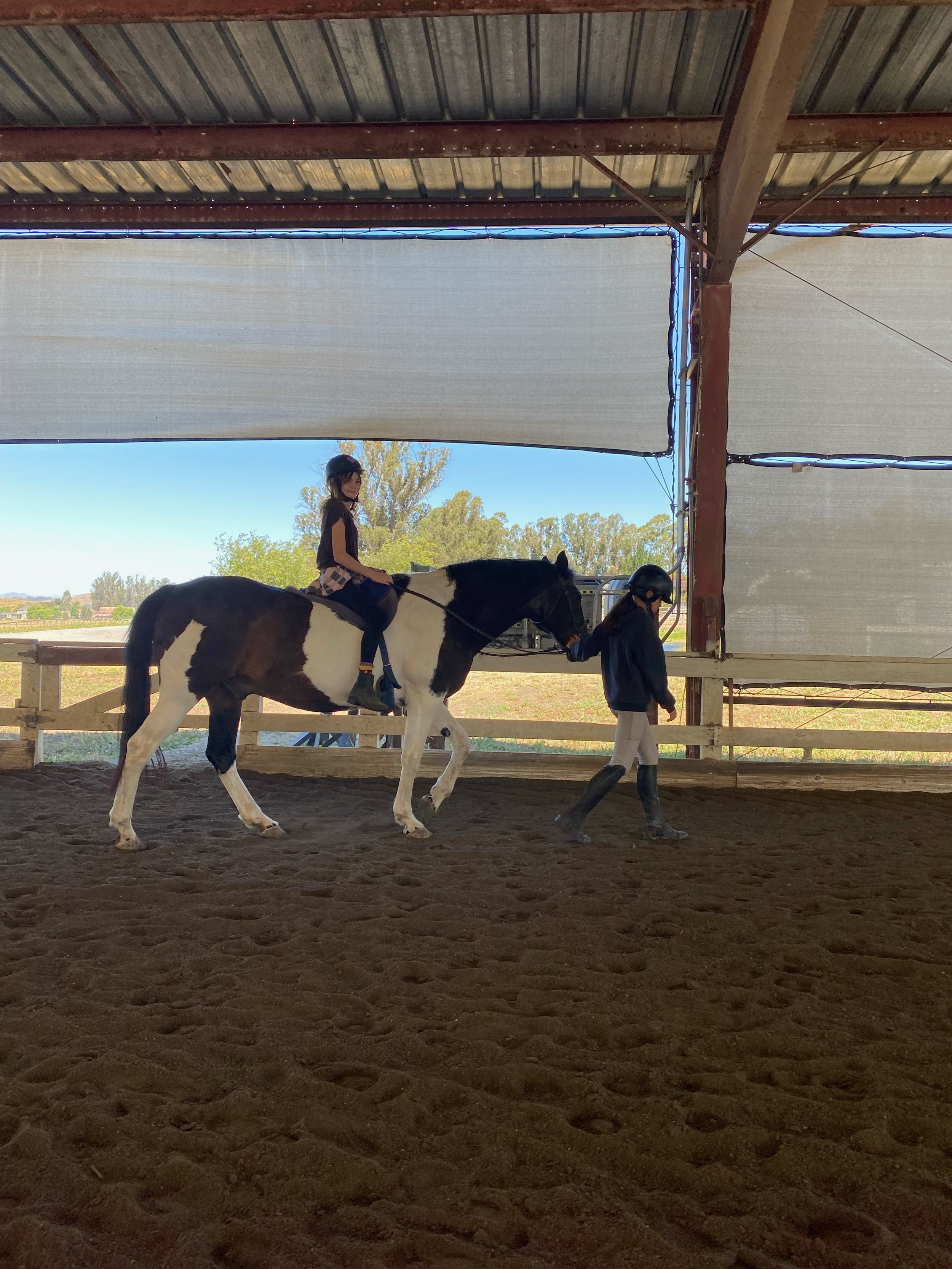
Why horses, out of everything?
Kids ask for a lot of things. A dog. A trampoline. Fifteen more minutes before bed. Most of those requests come and go. But there's something different about the way kids ask for horses. It's rarely casual. It's usually said with the kind of certainty you don't see in a kid asking for a new video game.
Part of that is because horses are just objectively wild to a kid's brain. They're enormous. They're strong enough to do whatever they want and choose, instead, to nuzzle your kid's shoulder. They have personalities, moods, opinions. A horse can be stubborn one day and sweet the next, and to a kid, that's not annoying, that's fascinating. It's the closest thing to a real-life fantasy creature they'll ever get to interact with, except this one is real, it's standing three feet away, and it just decided to trust them.
That's a hard thing to walk away from once you've felt it.
It's not really about the horse. At first.
Here's the part nobody tells you: most kids don't fall in love with riding because of the riding. They fall in love with the barn.
The smell of hay. The sound of hooves on packed dirt. A horse leaning its enormous head down to sniff their hand like they're the most interesting thing that's happened all day. Kids who spend their weekdays being told to sit still, raise their hand, wait their turn, walk into a barn and suddenly they're allowed to be a little louder, get dirty, and make some decisions, like which brush to use first or whether Biscuit needs his mane detangled before or after his hooves get picked.
That's not a phase. That's a kid finding a place where they get to be somebody.
We see it happen all the time! A kid walks in stiff and unsure, hovering near a parent's leg, not totally convinced this was a good idea. An hour later, they're covered in shavings, bickering with a friend about whose horse has the better personality, and asking if they can come back tomorrow instead of Saturday. Something happens in that hour that doesn't happen on a soccer field or in a dance studio, not because those activities aren't valuable, but because there's nothing else quite like being trusted with an animal that size.
The things you're actually worried about
Let's be honest about what's really going on in your head, because it's probably not "will my kid like horses." It's some version of these:
Is this safe? Horses are big animals, and handing your kid the reins feels like a leap. Reasonable. This is why we don't hand a seven-year-old a horse and a saddle on day one. Riders start on the ground, learning how to read a horse's body language, how to approach safely, how to lead, how to groom, long before they're anywhere near a saddle. Confidence comes from competence, not from being thrown into the deep end.
Will they actually stick with it? You've bought the soccer cleats that got worn twice. You know how this goes. But, usually the kids that ask for riding lessons have already decided it is their thing. It is not something you see all the time, it is not the most common afterschool activity and, if your child is asking for it, they have already spent time seeing themselves as a rider! And with riding, there's always a next thing to work toward. First it's staying balanced at a walk. Then a trot. Then learning to steer without yanking the reins like a car wheel. Then it's a whole horse to take care of, not just ride. There's always a next rung on the ladder, and that keeps kids coming back in a way that a season of soccer practice sometimes doesn't.
Is this going to turn into a money pit? We're not going to pretend riding is the cheapest activity out there. But we will say this: a structured program where your kid progresses, makes friends, and builds skills is a very different investment than one-off pony rides that never go anywhere. You're not paying for an hour on a horse. You're paying to have your child build solid skills that stick with them both inside and out of the arena, and that compounds.
Do I need to know anything about horses myself? No. Absolutely not! Some of our most devoted parents couldn't tell a bridle from a halter when they first showed up. They just knew their kid wanted this, and they figured out the rest by watching from the fence line, coffee in hand, slowly becoming the kind of person who has opinions about hoof care. That's the whole point of us being here. You don't need to be the expert. You just need to say yes.
What actually happens once they start
Riders don't get plopped on a horse and told to have fun. They start with the basics that build a solid foundation instead of just a fun afternoon: how to greet a horse, how to groom, how to tack up, how to be aware of an animal that outweighs them by roughly a thousand pounds. Then riding starts, and it's not just "sit up straight and hold the reins." It's balance, steering, rhythm, and eventually, real communication with an animal that can absolutely tell when a rider is faking confidence.
Somewhere in there, without really noticing it, kids start picking up things that have nothing to do with horses at all. Patience, because horses do not care about your schedule. Responsibility, because someone has to actually take care of this animal and it's not going to be you standing at the fence. Confidence, because there is nothing quite like realizing you just got a fifteen-hundred-pound animal to do what you asked it to do, using nothing but your body and your voice.
Somewhere around week six or seven, most parents notice something else. Their kid starts talking differently about mistakes. A horse doesn't respond to a cue, and instead of getting frustrated and quitting, the kid tries again, adjusts, tries a different approach. That's not something we teach in a lesson plan. That's just what happens when a kid spends enough time working with an animal that doesn't care about excuses and doesn't respond to a tantrum. Horses are honest in a way that few things in a kid's life are. They react to what's actually happening, not what your kid wishes was happening, and that kind of honest feedback builds a different kind of resilience than a trophy for participation ever will.
And then there's the part that surprises parents the most: the friends.
The community part is not an afterthought
A lot of activities are built around a child and an instructor. Riding, at least the way we do it, is built around a child and a barn full of other children who are all figuring this out together. Riders show up on the same days, groom horses next to each other, cheer each other on when someone nails a new skill, and commiserate when a horse decides today is the day it's not listening to anybody.
That kind of community doesn't happen by accident. It happens because kids are working toward something together, week after week, season after season. Ask any parent whose child has been riding for a year or two what their favorite part is, and it's rarely just "the horses." It's usually some version of "this is where their friends are," or "this is the one activity they never want to skip."
There's also something worth saying about the adults in this picture, because it's not just the kids who end up part of something. Barn parents talk to each other in a way that carpool line parents mostly don't. You're standing around for an hour while your child grooms a horse or works through a lesson, and somewhere in there you end up trading notes with another parent who's exactly as unsure about horses as you are. That's its own small community, built on the same thing your kid's is built on: showing up for the same thing, over and over, until it stops feeling new and starts feeling like yours.
What progress actually looks like
If you're picturing your kid cantering around a ring within the first month, pump the brakes a little, in a good way. Real horsemanship is built slowly and on purpose, because that's what actually builds confident, capable riders.
The early weeks are mostly about the ground. Learning to read a horse's ears and body language, understanding personal space around such a large animal, brushing out a coat, picking hooves, learning why a horse gets tacked up in a specific order and not just whatever feels easiest. It can feel slow to a parent watching from outside the arena. It rarely feels slow to the kid, because every one of those steps is new and interesting to them in a way it stopped being interesting to us adults a long time ago.
Then riding starts, and it's still not about speed. It's about posture, balance, learning to steer with legs and seat instead of just yanking on reins, understanding that a horse responds to calm, clear signals and not to panic. Every rider progresses at a different pace, because every horse-kid pairing is different, and that's the point. This isn't a program built to rush kids through a curriculum. It's built to actually turn them into capable, confident riders who understand the animal they're working with, not just how to sit on top of one.
So what do you actually do with "I want to ride horses"?
You say yes, and then you find a place that's built for exactly that moment. Not a place that treats your kid like a tourist getting a pony ride, and not a place that assumes they already know what they're doing. A place built around the actual arc: come ride, learn horsemanship, build real skills, make friends, have fun, and become part of something that sticks.
That's what we built at Strides. Riders come to us in Petaluma from all over Sonoma County, and most of them start exactly the same way yours might: a kid who wants to ride, and a parent with a few good questions.
We've got answers for the questions. We've also got the horses, the instructors, and the community that turns "I want to ride horses" into something your kid actually grows up with.
Come see what that looks like. Book an intro lesson and let your kid tell you the rest.