
What Age Can Children Start Horseback Riding? An Honest Answer From 18 Years at the Barn
I get this question constantly, usually by email and socials.
"My daughter is obsessed with horses. She's four. Is that too young?"
Eighteen years of teaching children at our barn in Petaluma, and here's what I can tell you for sure: there is no magic number. Age gets you in the door, but readiness is what matters, and readiness looks completely different from child to child.
I've taught six year olds who were locked in and ready from lesson one. I've taught nine year olds who needed a whole extra season before it clicked. The birthday on the cake tells me almost nothing.
So instead of giving you a number and sending you on your way, let me walk you through what I look for, what a first lesson really looks like, and how to tell if your child is standing at the gate ready to go, or just really, really into the idea of horses right now. Both are great, by the way. They just point you toward different next steps.
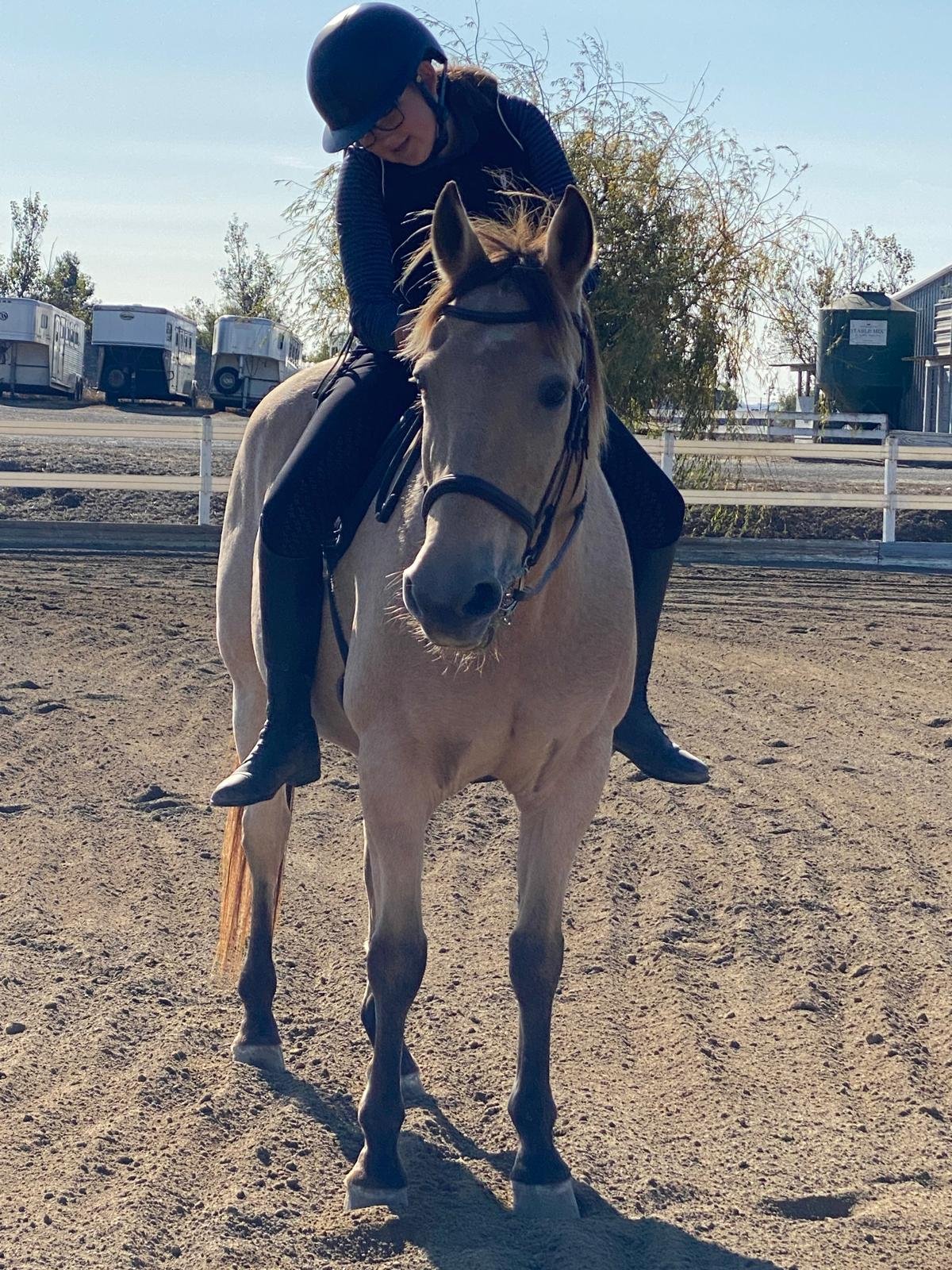
So what's the youngest age?
At Strides, our regular lesson program starts at 5.
That's not a number we picked out of a hat. By around age five, most children can do a few key things at the same time: follow instructions from an adult who isn't their parent, sit upright and balanced without needing constant reminders, and stay reasonably locked in for about thirty minutes.
Those three things matter way more than height, more than "she rode a pony at the fair once," and more than how many horse books are stacked on her nightstand.
If your child is under five, that doesn't mean horses are off the table. It just means our regular lesson program isn't the right entry point yet. There's still plenty of ways to get them around horses as they grow.
Is four too young? What changes between five and seven?
Four is generally too young for our regular program, and I say that as someone who really loves having little children underfoot at the barn.
At four, most children are still building the skills to listen to an adult who isn't mom or dad, stay with one task, and follow a sequence of instructions. Those skills become a big deal fast once a child is trying to communicate with a thousand pound animal.
Five is our starting line, but even within five, children show up all over the map. Some five year olds walk in and are just ready, listening, engaged, curious about the horse in front of them. Others need a bit more runway before a structured lesson makes sense.
By seven or eight, something shifts. Children start connecting cause and effect in a way that changes everything. They stop just moving the reins and start noticing "oh, the horse turned because I did that." That's the moment riding stops feeling like sitting on a horse and starts feeling like a conversation.
Nine and up, children move through the fundamentals faster and start caring about progression, which is exactly where our Levels System starts to click for them.
None of this is a ranking. It's just a reminder that different ages need different things out of that first year.
How do you know if your child is ready?
Here's the mental checklist I run through when a family comes out for a first visit.
Can they take direction from someone who isn't you? Teachers, coaches, camp counselors, doesn't matter who. If they already listen reasonably well to another adult, riding tends to go a lot smoother.
Are they curious about the horse, not just the idea of a horse? Watch what happens when a real, large, occasionally sweaty animal walks up to them. Some children lean in immediately. Some grab your leg and hide behind you. Both are totally normal reactions. What I'm watching for is whether they want to get closer once the initial shock wears off.
Can they hang with one activity for about thirty minutes? Not perfectly. Wiggling is allowed. Generally is the key word.
Can they take correction without falling apart? Riding is a lot of gentle, constant correcting. Heels down. Sit up. Shorten your reins. Children who can hear that, try again, and keep going usually pick this up fast.
Are they cool with the reality of a barn? It's hot in summer and cold in winter out here in Sonoma County. There's dirt. There are flies. There are horses with their own opinions on any given day. If your child wants the whole experience, mess included, they're probably going to love it here.
If most of that sounds like your child, they're likely ready. If a few of those are still developing, there's zero rush.
Can a child be too old to start?
No. Really, no.
Children show up to riding at all kinds of ages, and there's no rule that says you have to start at five or six to become a solid rider.
Older beginners bring some real advantages to the table. They tend to pick up theory faster, remember corrections week to week, and understand the why behind what we're asking them to do.
They're also often more motivated, because riding was their idea, not something mom or dad signed them up for.
The real difference is just how they approach learning. A younger rider might be thrilled just grooming and walking laps around the arena. An older beginner is often already thinking about what's next. There's room for both.
What happens at a first lesson?
Most parents are surprised by how much of the first lesson happens on the ground.
Your child meets their horse before they ever get on. They learn how to approach, how to stand next to a horse safely, how to interact the right way. There's some grooming and a little intro to tack before anyone climbs in a saddle.
Then they ride, usually just at a walk, working closely with their instructor the whole time. This isn't about covering ground or cramming in everything at once. It's about getting comfortable, learning the basics, and letting the child feel what riding is.
Horsemanship starts on day one at Strides. Learning to ride isn't only about steering. It's also about understanding the horse underneath you and learning to talk to it.
That foundation carries them straight into our Levels System as they progress.
Fair warning: expect your child to be exhausted. Expect them to talk about the horse's name nonstop for a week straight. And expect at least one shockingly specific question at dinner about why horses sleep standing up.
Do we need to buy a horse or gear first?
No, on both counts. Please don't buy anything expensive yet.
We provide the horses. Beginners ride school horses who are experienced with new riders and matched carefully for each lesson.
Helmets are loaned by Strides for those first lessons. Once your rider commits to weekly lessons, we'll point you toward equestrian-approved helmets and the right gear from there.
You do not need to build a whole riding wardrobe on day one. We'll help you figure out exactly what you need as riding becomes a regular thing.
How often should a beginner ride?
Once a week is a great place to start for most children.
Consistency is what builds it, balance, coordination, skill, and familiarity with their horse, all of it comes from showing up weekly.
As they progress, camps and other programs are a great way to add more barn time. For children six and up, we run summer camps, and right now we've also got Single-Day Horse Camp available on select fall Saturdays if you want to give them extra time in the saddle.
What if my child is still too young right now?
If your child is under five and completely horse-obsessed, don't rush it.
Let that interest build on its own. Read the books. Watch the videos. Visit the barn when it makes sense. Talk about what horses are like in real life, not just what they look like in a movie.
Once they hit the right age, an Intro Lesson is the move. It lets your family see how they respond to the real thing before committing to weekly lessons.
Everyone at Strides starts with an Intro Lesson. From there, families who feel good about it move into our regular weekly program.
And again, for children six and up, camps are a fun way to spend more time around horses without committing to a weekly schedule yet.
The real question here
It's not really "how old does my child need to be."
It's "is my child ready to be curious, listen, try something new, and stay engaged for a lesson."
At Strides, our regular program starts at five, but readiness is still the thing that matters most. Some five year olds are ready to go immediately. Others do better waiting a little longer, and that's completely fine.
And if your child is older and just now discovering horses, you haven't missed anything. Children start at all kinds of ages and build their skills at their own pace.
We teach children and adults to ride out of our barn in Petaluma, serving families across Sonoma County. If you're wondering whether your child is ready, an Intro Lesson is the easiest way to find out.
Honestly, standing next to a real horse usually answers the question faster than any checklist ever could.